Color: how painters use it
Art · 3rd grade
Warm and cool colors
By the end, Theo will be able to sort colors into warm and cool families and notice how a painter uses both to show light and shadow.
About 20 minutes to teach
Teach the idea
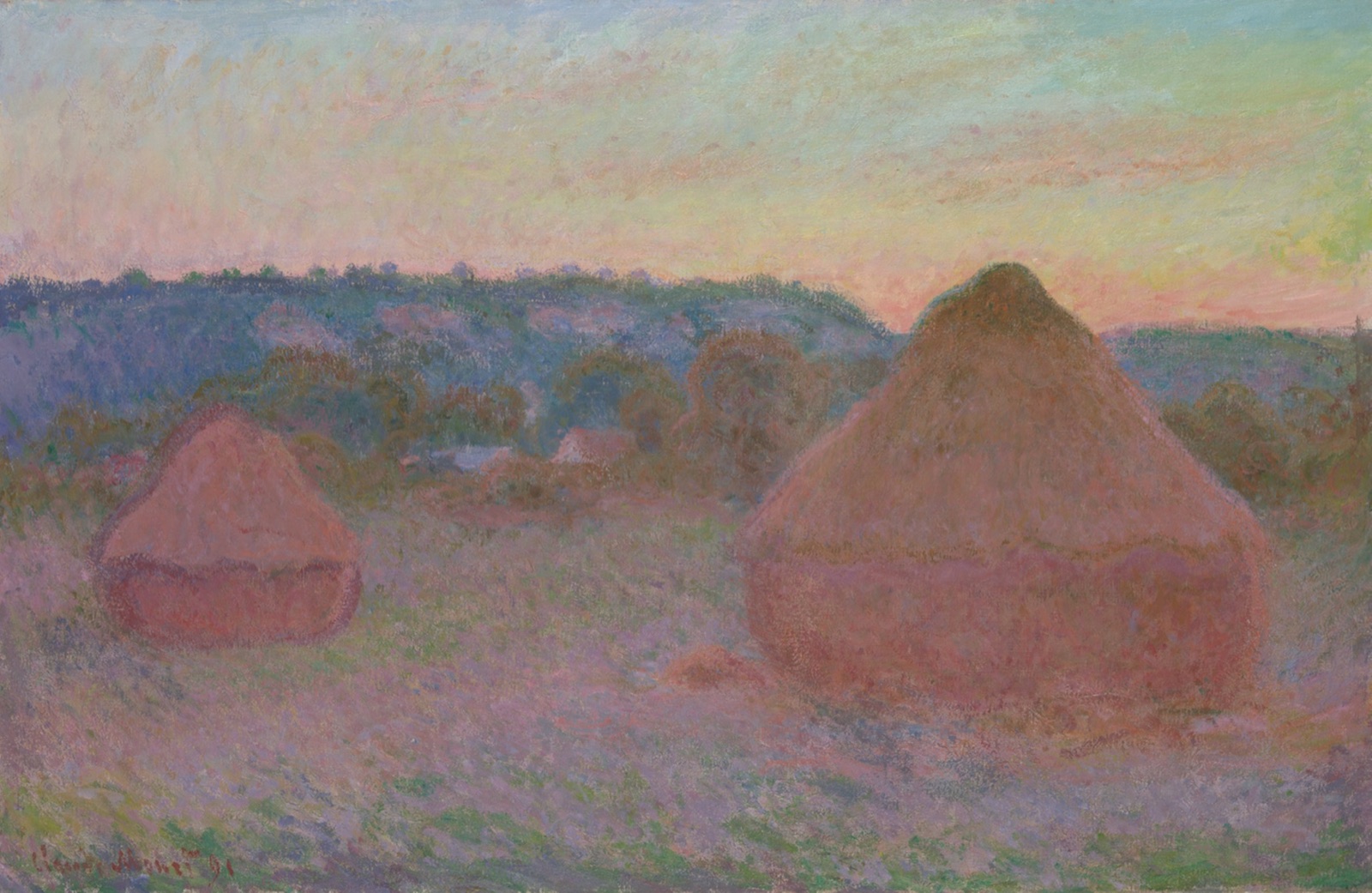
Look together
Ask one question at a time, and give time to look before you answer.
What time of day is it, and what season? How can you tell?
Look for: the end of the day, near sunset: the sky glows orange and pink along the hills. The title says autumn.
Find the warm colors: reds, oranges, yellows and pinks. Where are they?
Look for: the two stacks, the glow in the sky along the hills, and bits of the field.
Now find the cool colors: blues, purples and greens. Where are they?
Look for: the hills and trees behind the stacks, the pale green and blue at the top of the sky, and the purple in the field.
Straw is yellow. What colors did Monet paint the stacks instead, and why?
Look for: orange, red and pink, the color of low evening sunlight on them.
Read this together:About the picture
82 words
Claude Monet was a French painter who lived from 1840 to 1926.
The stacks of wheat were 15 to 20 feet tall. They stood just outside his farmhouse in Giverny, France.
In 1890 and 1891 he painted them again and again, in different seasons and at different times of day, sometimes at several easels at once.
In May 1891 he hung fifteen of these paintings side by side in one room of a gallery in Paris. The show was a great success.
Artists sort colors into two families. Warm colors are red, orange, and yellow. They are the colors of fire and the sun, and they seem to come forward toward you. Cool colors are blue, green, and purple. They are the colors of water, grass, shadow, and evening, and they seem to sit back. A painter can put warm colors where the light touches and cool colors where it does not, so the picture feels like real light and real shadow.
Do it together
1. Stand side by side at the big artwork at the top of the page. Point to the Look together questions printed right under it and work through them one by one with Theo. Let him point to the places he finds; stay with only what those questions ask.
2. After the looking, ask Theo which colors felt like they jumped forward and which ones felt quieter and farther back. Remind him the warm family is red, orange, and yellow, and the cool family is blue, green, and purple. In About the picture we learned he painted these same stacks again and again at different times of day; ask Theo where the evening light seems to touch in this one.
3. Open the sketchbook and set out the oil pastels or crayons so the warm ones and the cool ones are easy to grab. Then go straight to the activity below and make the warm-and-cool sunset together.
Activity
Together: A warm and cool sunset. 1. Draw a low hill line across the sketchbook page, a third of the way up, and one big wheat stack on the field. 2. Draw a small sun low in the sky on one side. That side is the sunny side. 3. Color the sky warm near the hill (yellow, then orange, then pink) and cool at the top (light blue, then purple). 4. Color the stack warm on the side facing the sun and cool (blue or purple) on the other side, with a cool shadow on the ground. 5. Color the hill and field mostly cool, with a little warm where the light would touch.
Tip If Theo rushes the coloring, slow down and ask him to press a little harder on the sunny side of the stack so the warm colors really glow. If he freezes on where to put cool colors, just point back at the artwork and let him copy the idea of cool shadow on the ground. Praise the choices he makes (you used a lot of orange right by the sun) and never compare his page to the painting.
On paper
Worksheet
Warm and cool
The worksheet, as it prints
Art · Worksheet
Warm and cool
Answer each question. Your child can answer out loud while you write.
Name: Theo
Score: ____ / 4
1. Name the three warm colors.
2. Name the three cool colors.
3. Warm or cool: a campfire, a lake, a lemon, a pine tree.
4. Monet painted the same stacks many times. What changed from one painting to the next?
This took Arbor about a minute
Your child’s year, written like this
Theo isn’t real. Arbor writes these for your kid: their name, what they love, and where they actually are in each subject.