Free printable · 10th grade
10th grade homeschool, on one page
The courses a 10th grader usually takes, what each one is worth in credits, and which ones Arbor writes for you.
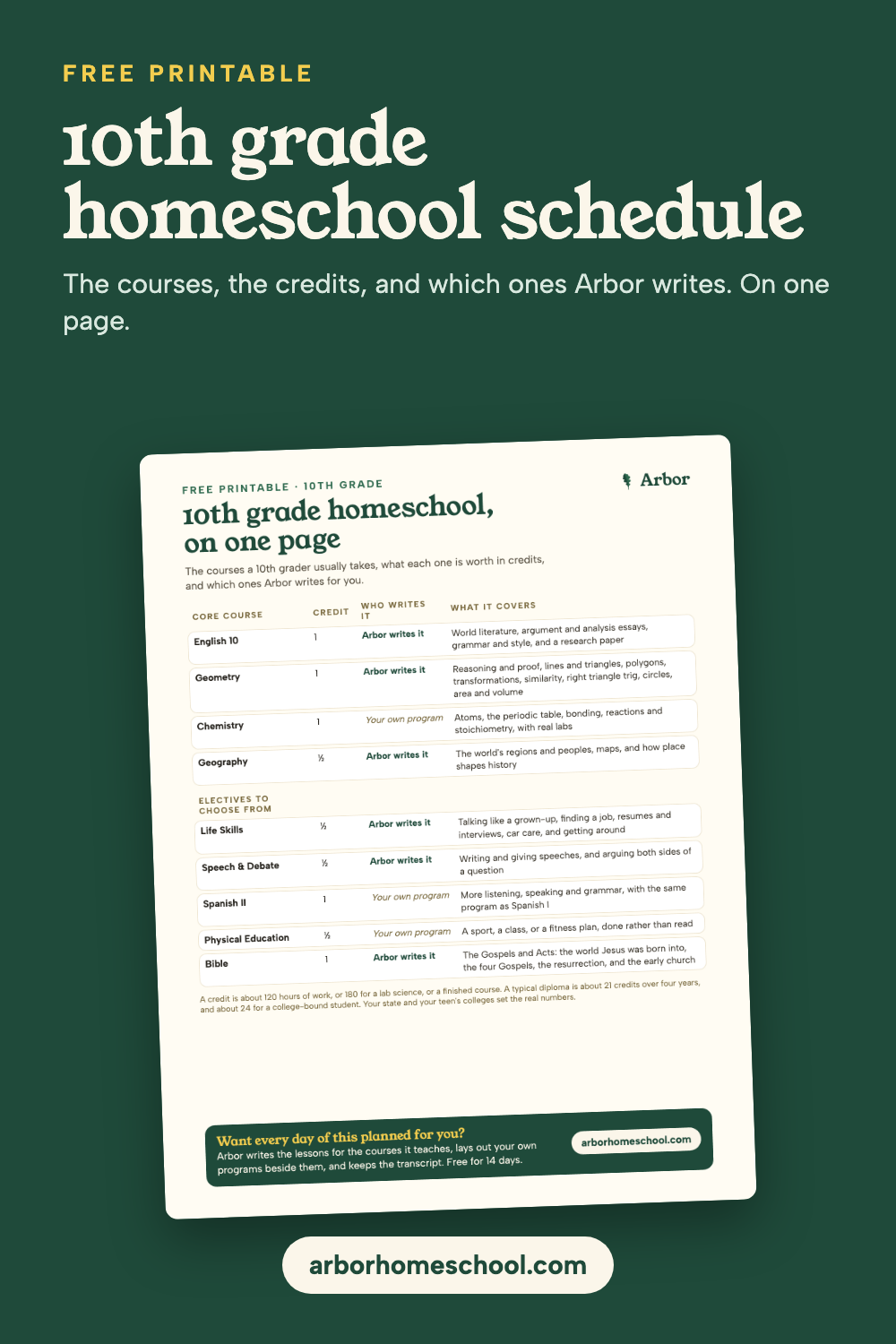
Arbor plans the whole year around these courses, writes the lessons for the ones it teaches, and keeps the hours and grades for the transcript. Free for 14 days.
The core courses
| Course | Credit | Who writes it | What it covers |
|---|---|---|---|
| English 10 | 1 | Arbor writes it | World literature, argument and analysis essays, grammar and style, and a research paper |
| Geometry | 1 | Arbor writes it | Reasoning and proof, lines and triangles, polygons, transformations, similarity, right triangle trig, circles, area and volume |
| Chemistry | 1 | Your own program | Atoms, the periodic table, bonding, reactions and stoichiometry, with real labs |
| Geography | ½ | Arbor writes it | The world's regions and peoples, maps, and how place shapes history |
3½ credits of core courses. A diploma takes about 5 to 6 credits a year, so add an elective or two.
Electives to choose from
| Course | Credit | Who writes it | What it covers |
|---|---|---|---|
| Life Skills | ½ | Arbor writes it | Talking like a grown-up, finding a job, resumes and interviews, car care, and getting around |
| Speech & Debate | ½ | Arbor writes it | Writing and giving speeches, and arguing both sides of a question |
| Spanish II | 1 | Your own program | More listening, speaking and grammar, with the same program as Spanish I |
| Physical Education | ½ | Your own program | A sport, a class, or a fitness plan, done rather than read |
| Bible | 1 | Arbor writes it | The Gospels and Acts: the world Jesus was born into, the four Gospels, the resurrection, and the early church |
What Arbor writes, and what needs your own program
Arbor writes English 10, Geometry, Geography, Life Skills, Speech & Debate and Bible. Geometry is Arbor’s own full-year course, 144 lessons, with every answer key checked.
Use your own program for Chemistry, Spanish II and Physical Education. A lab science needs real labs and equipment. A spoken language needs listening and speaking with a real program. PE is done, not read. Arbor puts your program on the schedule beside everything else and keeps its hours and grades for the transcript.
How the credits add up
A credit is about 120 hours of work, or 180 for a lab science, or a finished course. Most of Arbor’s high school lessons run 40 to 45 minutes, and Arbor counts the hours as you teach.
| Over four years | Typical | College-bound |
|---|---|---|
| English | 4 | 4 |
| Math | 3 | 4 |
| Science | 3 | 4 |
| Social Studies | 3 | 4 |
| Foreign Language | 0 | 2 |
| Fine Arts | 1 | 1 |
| PE & Health | 1 | 1 |
| Elective | 6 | 4 |
That is about 21 credits for a typical diploma and 24 for a college-bound student. These are common conventions, not law: your state and the colleges your teen applies to set the real numbers.
Want every day of this planned for you?
Arbor turns this into your teen's whole year: the lessons written out for every course it teaches, your own programs laid out by day beside them, and the transcript kept as you go. Free for 14 days.